
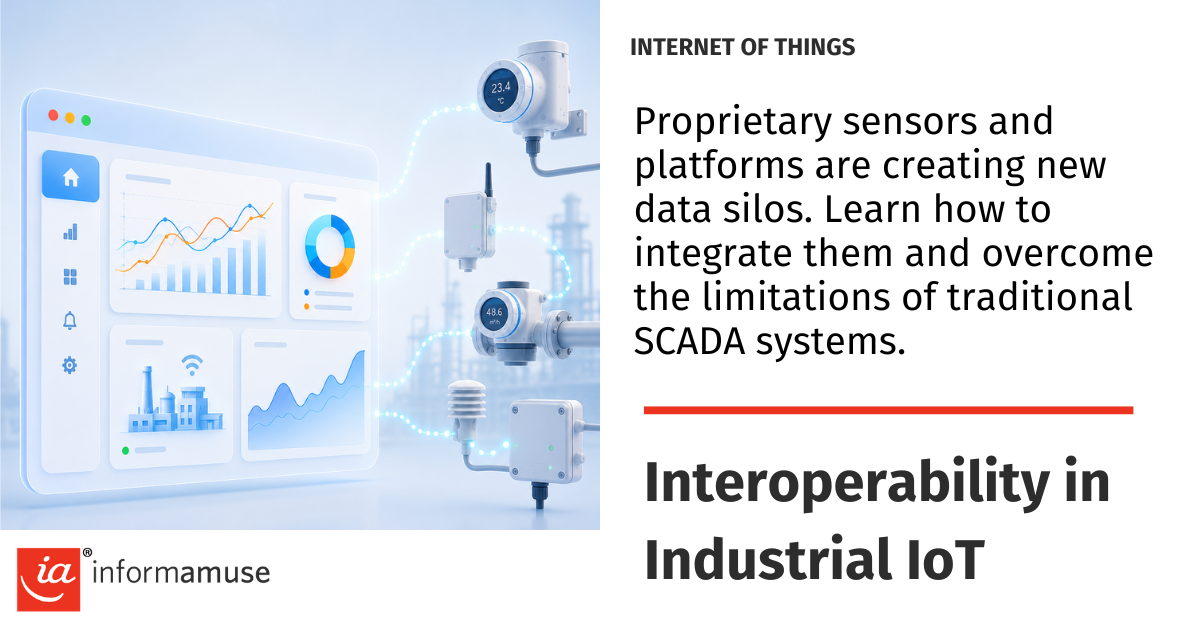
The adoption of connected sensors and devices has grown rapidly across every industrial sector. Energy monitoring systems, environmental sensors, PLCs, gateways, and telemetry devices are often introduced at different times and by different vendors. While this evolution has significantly increased the availability of data, it has also created a new challenge: the emergence of new data silos. Information is now spread across multiple platforms, separate dashboards, and applications that cannot communicate with one another. The result is increasingly complex plant management and a fragmented view of operational data.
The Limitations of Traditional SCADA Systems
SCADA systems remain essential tools for industrial control, but they were designed for a very different technological landscape. Today, companies must monitor distributed facilities, integrate heterogeneous devices, and manage data generated by a wide variety of technologies. In these scenarios, system integrations can become complex and expensive, while adding new devices or developing innovative services often requires significant customization. For system integrators, this means longer development times, higher implementation costs, and a strong dependence on proprietary technologies.
Why Interoperability Has Become Essential
The real challenge of Industrial IoT is no longer collecting data—it is making that data available in an integrated and meaningful way. A unified view of industrial assets enables organizations to correlate information from different sensors, build cross-functional KPIs, improve maintenance activities, and make faster, better-informed decisions. Interoperability has therefore become a fundamental requirement for companies seeking to unlock the full value of the data generated by their assets.
ADA: An Open and Vendor-Independent IIoT Platform
ADA was designed precisely to address this challenge. The platform enables the integration of sensors and devices from different vendors into a single management environment, collecting data from heterogeneous protocols and making it available through unified, fully customizable dashboards. Its multi-tenant architecture also allows organizations to manage multiple plants and multiple customers simultaneously while maintaining full control over both data and infrastructure. Rather than replacing existing technologies, ADA provides an integration layer that enhances their value and extends their capabilities.
A New Approach for System Integrators
For system integrators, an open platform such as ADA represents a genuine shift in perspective. It enables the development of vendor-independent solutions, reduces the time required to integrate new devices, and supports the creation of applications that can be replicated across multiple customers and industrial environments. In a market where interoperability, scalability, and data ownership are becoming strategic priorities, the ability to unify different technologies within a single platform provides an increasingly important competitive advantage.
From Monitoring to Data Value
The future of Industrial IoT does not lie in multiplying platforms, but in connecting different technologies and transforming isolated data into actionable insights. This is exactly where ADA creates value: by providing system integrators and industrial companies with an open, scalable, and vendor-independent ecosystem capable of overcoming the limitations of traditional architectures and turning data into a strategic asset.
