
When we talk about artificial intelligence, we often think of large models, cloud infrastructures, and systems capable of handling highly complex conversations or analyses. But not all AI necessarily has to work this way. For many business processes, the problem is much more specific: interpreting information, classifying it, and quickly deciding which action to take.
This is precisely where smaller, specialized models can become particularly interesting.
The biggest model is not always necessary
A bigger model is not necessarily the best model. It depends on the task. If we need to analyze complex documents, generate content, or handle an in-depth conversation, a large language model may be the right choice. But if we simply need to understand a situation and choose between a limited number of alternatives, it may be more effective to use a model specifically designed for that type of decision.
This is one of the approaches we are experimenting with in GREG AI Workspace. In our tests, we used a decision model to interpret a request and classify the context according to predefined criteria. The goal is not to generate a long response, but to quickly reach a decision that can be used by the workflow.
From request to action
To make the concept immediately understandable, we chose a simple example: a waste bin.
The system receives a request, identifies the type of waste, and returns the classification needed by the workflow to determine the next action.
Plastic, glass, organic waste, paper: behind an apparently simple case lies a much more general sequence:
information → interpretation → classification → decision → action
During testing, this approach was applied to the management of different types of waste, using a decision model integrated into the GREG workflow.
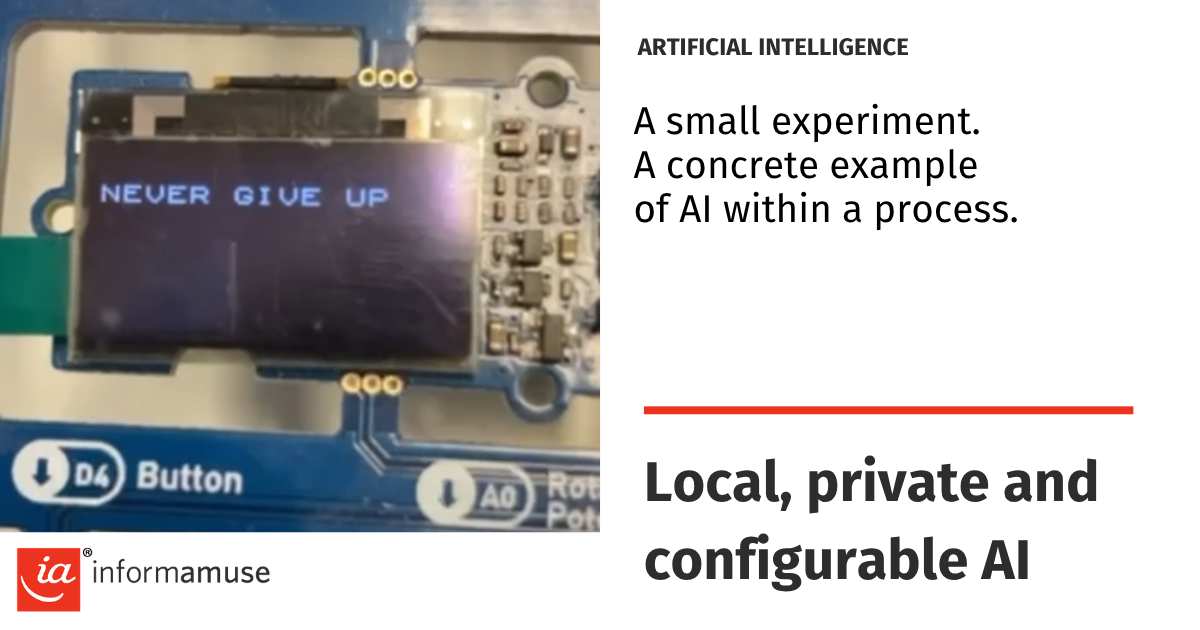
A simple test with GREG AI Workspace: the model interprets the context and returns the classification the workflow can use to determine the next action.
The waste bin, of course, is only a demonstration. The real value lies in the mechanism behind it.
Bringing AI closer to the process
When a model is small, specialized, and requires limited resources, it becomes possible to run it increasingly close to the point where data is generated and decisions need to be made. This is the principle of Edge AI.
Depending on the application, this may mean using a company workstation, a mini PC, an industrial gateway, or other sufficiently powerful devices. Not everything therefore needs to pass through a large cloud infrastructure. In certain architectures, this can help reduce latency, maintain greater control over data, and limit dependence on external services.
AI that can be configured
There is another equally important aspect: making artificial intelligence usable within business processes without having to build a new application from scratch every time.
In GREG, a model can become one of the components of a workflow. An event triggers the process, the model interprets the context, makes a decision, and the result is used to determine the next action.
Rules and criteria can therefore be configured according to the specific scenario. AI stops being merely a tool to interact with and becomes an operational component of the process.
From waste bins to business processes
The same principle can be applied to many different scenarios. Among the areas we are exploring are ticket triage, routing, hardware and software automation, robotics, resource planning, anomaly detection, predictive maintenance, home automation, business intelligence, data analytics, and Edge AI for wearable devices.
Different applications, but with a common logic: quickly understand a situation and turn that understanding into a decision. And when the problem is sufficiently well defined, an enormous model is not necessarily required.
